- 8 Sections
- 48 Lessons
- 3 Quizzes
- 11 Assignments
- 22h Duration
Module 1: Introduction to Agentic AI
Module 2: AI Fundamentals
- Lecture 4 Agentic AI Tools (Introduction)
- Lecture 4 Manual Agentic AI Tools (Introduction)
- Quiz: Agentic AI Fundamentals (Lecture 1–4)
- Lecture 5 Recording AI Tools for Agentic AI (Deep Dive + Comparison)
- Lecture 5 Manual Top AI Tools for Agentic AI (Deep Dive + Comparison)
- Assignment 3
- Lesson 6 AI Workspace Setup Manual
- Assignment 4
Module 3: Tools & Environment Setup
- Lecture 7 Build Your First AI Agent
- Lecture 7 Manual Build Your First AI Agent
- Assignment 5
- Lecture 8 Upgrade Your AI Agent (Interactive + Personalized)
- Lecture 8 Manual Upgrade Your AI Agent (Interactive + Personalized)
- Assignment 6
- Lecture 9 Building Your First Real Automation System
- Lecture 9 Manual Building Your First Real Automation System
Module 4: Prompt Engineering
- Lecture 10 Integrating AI into Automation Using Make.com
- Lecture 10 Manual Integrating AI into Automation Using Make.com
- Assignment 7
- Lecture 11 Manual Enhancing AI Automation System (HTML Emails and Reply-Based AI Workflow)
- Lecture 11 Enhancing AI Automation System (HTML Emails and Reply-Based AI Workflow)
- Quiz 2: AI Agents & Automation Systems (Lecture 5–10)
- Lecture 12 Building AI Agents with Memory Using Make.com
- Lecture 12 Building AI Agents with Memory Using Make.com
- Assignment 8
Module 5: Building AI Agents
- Lecture 13 System Build Building a Multi-Role AI Agent System on Make.com
- Lecture 13 System Build Building a Multi-Role AI Agent System on Make.com
- Lecture 14 Building a Multi-Agent PR Campaign System with Tracking and Reminders
- Lecture 14 Manual Building a Multi-Agent PR Campaign System with Tracking and Reminders
- Lecture 15 Manual Building an AI Campaign Execution System
- Lecture 15 Building an AI Campaign Execution System
Module 6: Training, Testing & Evaluation
- Lecture 16 – Building an AI Operational Brain System on Make.com
- Lecture 16 – Building an AI Operational Brain System on Make.com
- Lecture 17 Manual Attaching Real Tools to AI Agents on Make.com
- Lecture 17 Manual Attaching Real Tools to AI Agents on Make.com
- Lecture 18 Manual Introduction to n8n – Building Production-Level AI Systems
- Lecture 18 Introduction to n8n – Building Production-Level AI Systems
Module 7: Deployment & Ethics
- Lecture 19 Manual Building Your First AI Research Assistant Agent in n8n
- Lecture 19 Building Your First AI Research Assistant Agent in n8n
- Assignment 9
- Lecture 20 Manual Building an AI Research Knowledge Vault Using n8n & Supabase
- Lecture 20 Manual Building an AI Research Knowledge Vault Using n8n & Supabase
- Lecture 21 Manual Building a RAG Agent in n8n Creating an AI Assistant That Can Read Documents
- Lecture 22: AI Executive Assistant – Tool Calling Agents
- Lecture 22: AI Executive Assistant – Tool Calling Agents
- Lecture 23: AI Client Onboarding, Proposal & Project Management System
- Lecture 23: AI Client Onboarding, Proposal & Project Management System
- lecture 24
- Lecture 25
- Lecture 26 Manual Building a Real AI SaaS Application with Credits System
- Lecture 26 Building a Real AI SaaS Application with Credits System
- Batch 1 - Agentic AI Final Project Selection
Module 8: Projects & Real-World Use
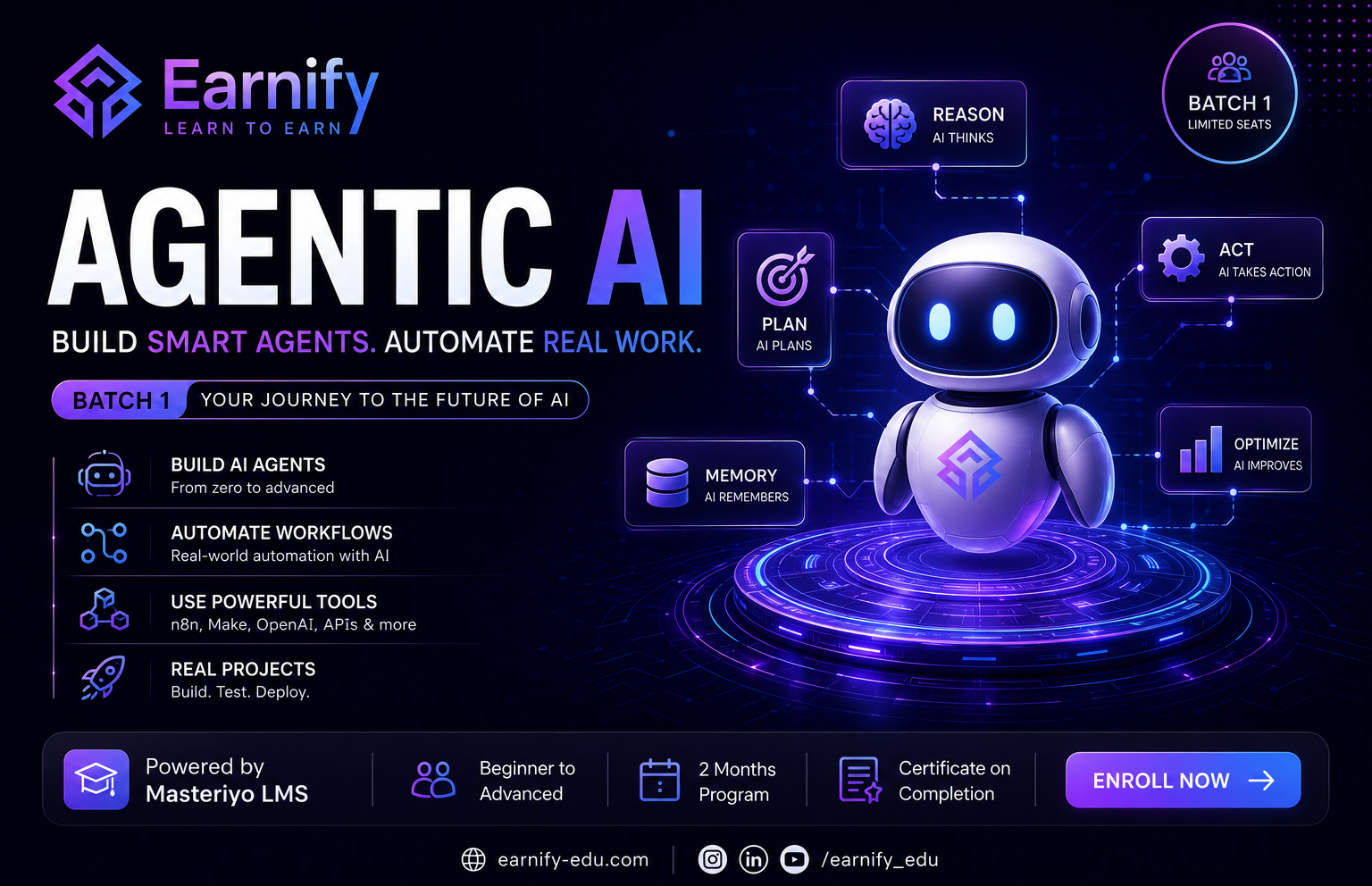
This advanced-level course introduces you to Agentic AI — a powerful new approach where AI systems can plan, decide, and act independently to solve complex problems.
You will learn how to design and build autonomous AI agents that can perform tasks such as content generation, decision-making, data analysis, customer support, and workflow automation.
Course Synopsis :
The Agentic AI Program is a live, structured training that teaches how modern AI systems are designed to plan, decide, and execute tasks autonomously. Students learn prompt engineering, agent workflows, automation, and integration with real tools to build practical AI solutions. The course focuses on understanding how intelligent systems work rather than just using AI tools. By the end, learners can design and implement real-world AI agents and workflows.
Course Learning Objectives :
Module Details
Module 1 - Foundations of Agentic AI
Understanding how modern intelligent systems actually work
What you will understand
This module builds the mental model of agent-based AI. Instead of seeing AI as a chatbot, you will understand how intelligent systems interpret goals, make decisions, and execute actions step-by-step.
What you will do
-
Break down real AI applications into workflows
-
Define goals and tasks for an agent
-
Map decision flow of an AI system
-
Set up the working environment
Tools used
ChatGPT interface, workflow diagrams, system prompts
Outcome
After this module you can explain how autonomous AI systems operate and think in workflows instead of prompts.
Module 2 - Prompt Engineering & Control
Controlling AI behavior instead of guessing responses
What you will understand
You will learn how prompts act as instructions that shape reasoning, reliability, and output structure. The focus is on predictable and repeatable results.
What you will do
-
Write structured prompts
-
Guide reasoning step-by-step
-
Prevent incorrect outputs
-
Create reusable prompt templates
Tools used
ChatGPT, structured prompting patterns
Outcome
After this module you can reliably control AI outputs for consistent results.
Module 3 - Agent Architecture
Designing systems that plan and execute tasks
What you will understand
This module explains how agents are internally structured using planners, memory, tools, and execution logic. You will move from single responses to multi-step systems.
What you will do
-
Design an agent workflow
-
Define tasks and actions
-
Simulate multi-step decision making
-
Build mini agent systems
Tools used
ChatGPT, workflow logic concepts
Outcome
After this module you can design a working agent workflow instead of isolated prompts.
Module 4 - Knowledge & Retrieval Systems (RAG Concepts)
Teaching AI to use real information instead of guessing
What you will understand
You will learn why AI sometimes produces incorrect information and how modern systems solve this using external knowledge and retrieval methods.
What you will do
-
Prepare information sources
-
Connect agent to external data
-
Reduce hallucinations
-
Build a knowledge-based assistant
Tools used
ChatGPT, retrieval workflow concepts, structured context handling
Outcome
After this module you can create AI assistants that answer using real data.
Module 5 - Tools & API Integration
Making AI interact with the real world
What you will understand
AI becomes powerful when it can use tools. This module focuses on connecting agents with external services and actions.
What you will do
-
Understand APIs & webhooks
-
Connect agent with services
-
Trigger external actions
-
Handle errors and responses
Tools used
Postman, APIs, webhooks
Outcome
After this module you can connect AI with real services and automate tasks.
Module 6 - Automation Workflows (n8n)
Turning AI into automated systems
What you will understand
You will learn how automation platforms allow agents to perform real operations across multiple applications and steps.
What you will do
-
Build workflows in n8n
-
Connect AI with automation
-
Create multi-step task execution
-
Run end-to-end processes
Tools used
n8n, automation workflows
Outcome
After this module you can build AI automation systems instead of manual processes.
Module 7 - Evaluation & Optimization
Making systems reliable and production-ready
What you will understand
This module focuses on improving reliability, measuring performance, and refining agent behavior.
What you will do
-
Test outputs systematically
-
Improve prompts iteratively
-
Debug workflow failures
-
Optimize responses
Tools used
Testing methods, structured evaluation
Outcome
After this module you can refine and stabilize AI systems for real use.
Module 8 - Final Project & Deployment
Building a complete real-world agent
What you will understand
You will combine all learned concepts into a functional system.
What you will do
-
Design a complete AI workflow
-
Integrate tools and automation
-
Build and demonstrate project
-
Present solution
Tools used
Full stack from previous modules
Outcome
After this module you will have a complete working AI agent project for portfolio use.
Free Lesson Videos: