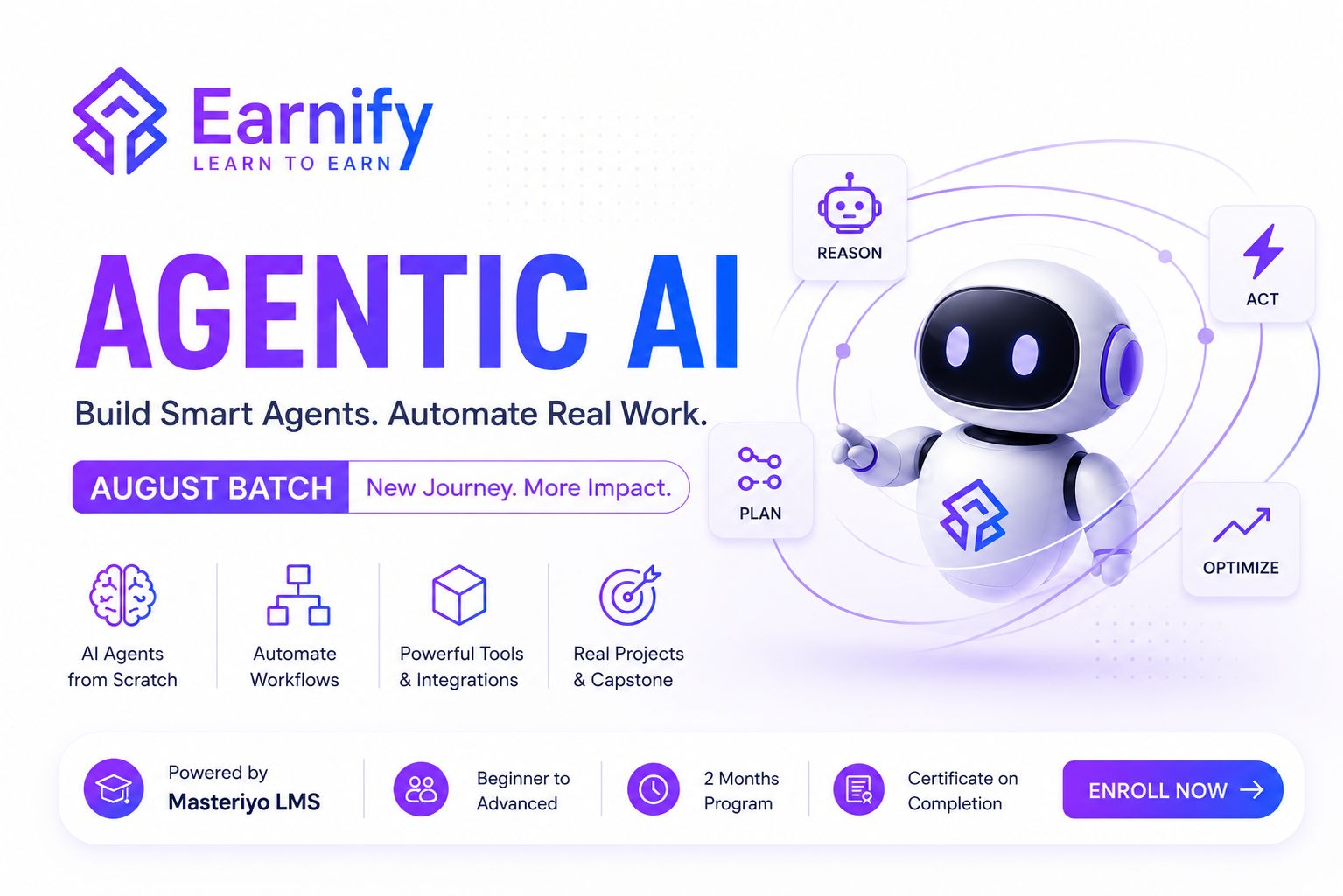
Agentic AI Engineering August Batch
Original price was: ₨ 35,000.₨ 27,000Current price is: ₨ 27,000.
Agentic AI Engineering Program
Course Structure & Learning Framework
1. Course Information
| Course Title | Agentic AI Engineering Program |
|---|---|
| Duration | 12 weeks (3 months) — 9 weeks live instruction + 15-day final project + 15-day career workshop |
| Total Live Lectures | 27 (3 classes per week) |
| Mode of Delivery | Live online classes (Zoom) supported by LMS recordings and resources |
| Class Schedule | Monday, Wednesday & Friday — evening sessions (timings announced per batch) |
| Instructors | Ali Hussain, Ume Farwa, Dr. Arham Muslim |
| Contact | 0319-5027701 | earnify@earnify-edu.com | www.earnify-edu.com |
| Prerequisites | Basic computer literacy; no programming background required |
2. Course Synopsis
This program is a live, structured training in the engineering of agentic AI systems — intelligent systems that plan, make decisions, use tools, and execute multi-step tasks autonomously. Students progress from AI workflow fundamentals and advanced prompt engineering to building practical agents on Make.com and n8n, including tool-calling agents, multi-agent systems, agent memory, cloud databases (Supabase), Retrieval-Augmented Generation (RAG) with vector stores, voice AI agents (ElevenLabs), and autonomous multi-workflow business systems with human-in-the-loop approval.
The program concludes with the development and deployment of a complete AI SaaS product with user management and a credits-based billing model, followed by a guided final project and a career workshop on freelancing and job hunting. The focus throughout is on understanding how intelligent systems work and building production-ready solutions rather than merely using AI tools.
3. Course Learning Objectives (CLOs)
By the end of this program, learners will be able to:
| CLO | Learning Objective |
|---|---|
| CLO 1 | Explain the structure and working of agent-based AI systems and distinguish automation, AI workflows, and AI agents. |
| CLO 2 | Apply advanced prompt engineering techniques to control and guide AI behavior reliably. |
| CLO 3 | Design and build multi-step and multi-agent AI workflows that plan and execute tasks autonomously on Make.com and n8n. |
| CLO 4 | Develop tool-calling AI agents integrated with APIs, external services, and business applications. |
| CLO 5 | Implement agent memory, cloud databases (Supabase), and Retrieval-Augmented Generation (RAG) for grounded, custom-knowledge agents. |
| CLO 6 | Construct autonomous, event-driven business systems with human-in-the-loop approval, including voice-enabled agents. |
| CLO 7 | Evaluate, debug, and harden AI agents for production using guardrails, error handling, logging, and cost control. |
| CLO 8 | Build, deploy, and commercialize a complete AI SaaS product, and present it professionally to clients and employers. |
4. Teaching & Learning Methodology
| No. | Type | Implementation |
|---|---|---|
| 1 | Active learning | Students learn by doing: during live sessions they build, test, and debug AI agents through guided tasks and real-time problem solving. |
| 2 | Cooperative learning | Students collaborate in small groups to design and build agent workflows, discuss approaches, divide tasks, and review each other’s work. |
| 3 | Blended learning | Live instructor-led sessions are combined with LMS-based recordings, resources, and between-session assignments for continuous learning. |
| 4 | Project-based learning | Every module ends in a working system; assessments accumulate into one portfolio, concluding with a guided real-world final project. |
5. Course Contents — Phase 1: Live Instruction (Weeks 1–9)
| Module | Lectures | Topics |
|---|---|---|
| 1. Foundations of Agentic AI | 1–3 | Traditional vs generative vs agentic AI; anatomy of an autonomous agent; advanced prompt engineering (6-part framework); system vs user prompts; automation vs AI workflow vs AI agent; trigger–reasoning–action–result; human-in-the-loop design. |
| 2. AI Tools & Automation Foundations | 4–6 | AI tool ecosystem; Make.com vs n8n; cloud vs self-hosted automation; API credentials, integrations and security; building and testing a first complete AI automation workflow. |
| 3. Practical AI Agents with Make.com | 7–10 | AI content creation agent; AI communication agent (Gmail automation, context-aware replies); agent memory and persistent data; multi-agent systems, handoffs and collaboration. |
| 4. Advanced Multi-Agent Business Automation | 11–14 | Five-agent marketing campaign system; JSON-based agent communication, routing and structured data; autonomous scheduling and distribution agents (social media, WhatsApp, calendar); complete AI campaign operating system with approval points. |
| 5. Professional Agent Engineering with n8n | 15–18 | n8n architecture: nodes, expressions, executions, credentials; AI research and planning agent; tool-calling AI agents (AI Agent node, tools, decision-making); advanced multi-tool AI assistant. |
| 6. Databases, Memory & RAG | 19–21 | Multi-stage research assistant agents; AI knowledge vault with Supabase (tables, storage, retrieval); RAG concepts, embeddings and vector stores; importing custom datasets; grounded, hallucination-resistant knowledge agents. |
| 7. Advanced Autonomous Business Agents | 22–23 | Executive AI assistant with autonomous tool selection, memory and action boundaries; autonomous project acquisition and delivery system (three connected workflows: acquisition, approval/communication, execution); event-driven agents and orchestration. |
| 8. Voice AI Agents (ElevenLabs) | 24 | Text-to-speech and voice cloning; conversational voice agent design; connecting voice agents to n8n workflows; use cases: voice receptionists, support lines, booking assistants. |
| 9. Deployment, Publishing & Commercialization | 25 | Publishing options: web apps, APIs, webhooks, embedded and white-label agents; hosting; pricing models: subscriptions, usage-based billing, credits systems, retainers; client ownership vs managed services. |
| 10. Building a Real AI SaaS Product | 26–27 | Full-stack AI SaaS live build (Lovable frontend, n8n webhook API, Supabase user validation, credits check, AI agent, billing logic); production-grade reliability: failure modes, hallucination control, validation, retries, fallbacks, logging, guardrails, cost tracking; capstone kickoff. |
6. Phase 2 — Final Project (15 Days)
Each student develops one complete, real-world agentic AI system under instructor supervision, selected from 15 professional project tracks (for example: customer support and action agent, sales and lead management agent, recruitment screening agent, research and report generation agent, appointment and booking agent, multi-agent business operations system) or a self-proposed project.
Every project must demonstrate:
- A clearly defined real-world problem
- Multi-step reasoning
- Tool/function calling with real data or services
- Structured outputs and error handling
- Memory where required
- Human approval before critical actions
- A professional working demonstration presented on Demo Day
7. Phase 3 — Freelancing & Job Hunting Workshop (15 Days)
A practical career workshop covering:
- Positioning as an AI automation specialist
- Building Upwork and Fiverr profiles and gigs
- Writing effective proposals
- Pricing services: projects, retainers, and credit-based offers
- Client communication and delivery
- CV and portfolio presentation
- LinkedIn optimization
- Interview preparation
- A personal 30-day post-graduation action plan
8. Assessment Structure
| Assessment | Coverage / Focus | Weightage |
|---|---|---|
| Quiz 1 | Agentic AI foundations, prompt engineering, and AI workflows (Modules 1–2) | 5% |
| Quiz 2 | Agents, memory, and multi-agent systems (Modules 3–4) | 5% |
| Assignment 1 | Build a complete AI-powered automation workflow | 6% |
| Assignment 2 | Design and build a multi-agent business automation system | 6% |
| Assignment 3 | Tool-calling AI assistant with at least three external capabilities | 6% |
| Assignment 4 | Database-connected knowledge agent using Supabase and RAG on custom data | 6% |
| Assignment 5 | Connected multi-workflow agent system with approval and action stages | 6% |
| Major Project | Complete AI SaaS application with frontend, backend, database, and credits system | 25% |
| Final Capstone | Production-ready agentic AI product, demonstrated on Demo Day | 35% |
| Total | 100% | |
Note: All assessments are cumulative — each builds toward the student’s final portfolio of 5–7 working agent systems plus one deployed capstone product. Certification is awarded on successful completion of all assessment components.
9. Software & Technologies Used
| Category | Tools / Notes |
|---|---|
| LLMs | OpenAI / ChatGPT APIs, Claude, Gemini |
| Automation & Agent Platforms | n8n (primary), Make.com |
| APIs & Integration | REST APIs, webhooks; Gmail, WhatsApp, Google Calendar, Google Sheets |
| Knowledge & Retrieval | Supabase (cloud database), RAG, embeddings and vector store concepts |
| Voice AI | ElevenLabs (text-to-speech, voice cloning, voice agents) |
| Frontend & Deployment | Lovable (AI app builder), webhook APIs, credits and billing logic |
| Docs & Delivery | Earnify LMS, Zoom live sessions, session recordings |
10. Learning Management System (LMS) Support
- Access to structured course modules through the LMS
- Session recordings available after live classes
- Supporting resources, templates and workflow files uploaded regularly
- Progress tracking throughout the program
- 24/7 chat support and student community for interaction and collaboration
11. Enrollment Information
This is a batch-based program with limited seats to ensure quality learning and meaningful interaction. Early enrollment is recommended for those planning to join the upcoming batch.
For registration and queries:
Phone / WhatsApp: 0319-5027701
Email: earnify@earnify-edu.com
Website: www.earnify-edu.com